Showing posts with label Science. Show all posts
Showing posts with label Science. Show all posts
Wednesday, 8 August 2012
More cameras see light on Mars
With the mast now upright Curiosity's main cameras are waking up to greet the day. The navigational cameras were first to the bathroom. There are four of these, a pair on either side of the main cameras (which are still calibrating). All the mast cameras point the same direction, to give stereoscopic views wherever the mast head is turned.
 Here we are looking north, the rim of Gale crater rises in the distance. On the left, just below the centre line, are two apparent 'craters'. These were almost certainly blasted out by the thrusters on the sky crane as it hovered to lower Curiosity to the surface. Hi res colour must be soon.
Grow into these trousers... >>
Here we are looking north, the rim of Gale crater rises in the distance. On the left, just below the centre line, are two apparent 'craters'. These were almost certainly blasted out by the thrusters on the sky crane as it hovered to lower Curiosity to the surface. Hi res colour must be soon.
Grow into these trousers... >>

![[Stumble Upon]](http://cdn.stumble-upon.com/images/16x16_su_3d.gif)

A birds eye view of Curiosity
After it captured Curiosity (MSL) parachuting down, the Mars Reconnaissance Orbiter had another look at the landing site.
 MRO was a lot further away on this orbit pass so the resolution isn't so high, however the components which put Curiosity down safely are all clear. The sky crane and parachute are to the left of Curiosity, some 600m away. The heatshield is to the lower right. In about a week the orientation of MRO will be more favourable and another image is planned. Such images will help determine the exact position of Curiosity and let the rover team plan the next move once all the systems have been checked out.
Grow into these trousers... >>
MRO was a lot further away on this orbit pass so the resolution isn't so high, however the components which put Curiosity down safely are all clear. The sky crane and parachute are to the left of Curiosity, some 600m away. The heatshield is to the lower right. In about a week the orientation of MRO will be more favourable and another image is planned. Such images will help determine the exact position of Curiosity and let the rover team plan the next move once all the systems have been checked out.
Grow into these trousers... >>

Tuesday, 7 August 2012
Shadows of Martian Curiosity
OH WOW!
 Curiosity stands in Gale crater, looking forwards to the east-southeast, in the late afternoon. The long shadow of Curiosity reaches out towards the mountains some 6km away (it may be further). Is this the central peak of the crater? I'm not sure but possibly not. If it's a foohill what will Mount Sharp look like?
This still just a low res hazcam, though a front one this time, with the original fisheye view stretched out to look normal. The mast with the hi res cameras will be deployed tomorrow, also the High Gain Antenna has been deployed to give a direct link to Earth. It's working, but full speed comms won't come through till later. Data rates from MRO and Odyssey relays are to be increased so final data speeds will go up about 5x, maybe even to megabits/s ie slow broadband speeds in bursts. Stand by to be really amazed. Grow into these trousers... >>
This still just a low res hazcam, though a front one this time, with the original fisheye view stretched out to look normal. The mast with the hi res cameras will be deployed tomorrow, also the High Gain Antenna has been deployed to give a direct link to Earth. It's working, but full speed comms won't come through till later. Data rates from MRO and Odyssey relays are to be increased so final data speeds will go up about 5x, maybe even to megabits/s ie slow broadband speeds in bursts. Stand by to be really amazed. Grow into these trousers... >>
Another view of Curiosity's heatshield
As MRO was passing overhead Curiosity took it's own pictures with a camera on it's belly. With the parachute deployed the camera began clicking at 4 frames per second when the heatshield was dropped. Here's one of the first frames:
 NASA have put together a low res, 4fps video of the whole descent. You can see the heatshield fall away and watch for the dust cloud thrown up at the end by the thrusters. The high res images will come through in a day or two.
Grow into these trousers... >>

Grow into these trousers... >>
Flash, bang, wallop, what a picture!

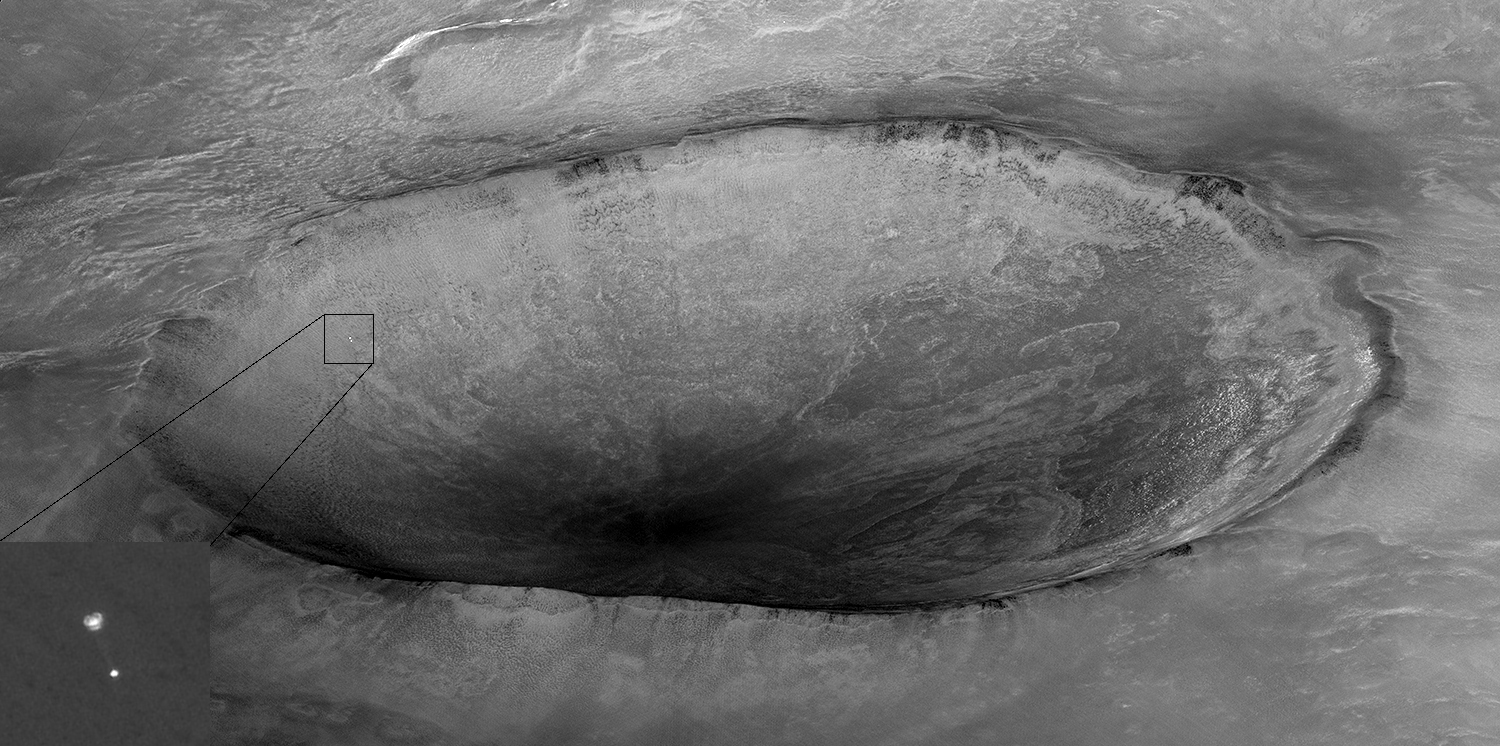
The Mars Reconnaissance Orbiter has done it again!* As it passed overhead the mighty HIRISE camera had one chance to capture the scene; here is the result. From over 300km away not only is Curiosity clearly visible, dangling on it's parachute, but below is the heatshield!
But look again. There is no disturbance on the surface around the heatshield, no crater, no dust cloud.
Conclusion - it's still falling!
I stand in awe of these guys - well no, in truth I sit because if I stand I'll pass out due to lack of sleep. Fuck the Olympics, the real action is 14 light minutes away on Mars.
*Four years ago MRO imaged the Phoenix lander in it's descent to the surface. Grow into these trousers... >>
Tuesday, 3 April 2012
Dust That Sings
Following on from my post by Neil DeGrasse Tyson, YouTuber philhellenes gives his take on the subject.
Ramp up the quality, make it full screen and enjoy...
Dust That Sings [12:37]
Grow into these trousers... >>
Ramp up the quality, make it full screen and enjoy...
Dust That Sings [12:37]
Grow into these trousers... >>
Wednesday, 14 March 2012
The Most Astounding Fact
I realise that I've not been active round here for a while. Sorry to the world and thanks to NobblySan for the nudge.
What is the most astounding fact about the Universe? A deep question which has tied up philosophers, theologians and scientists for millennia. The astrophysicist Neil DeGrasse Tyson was asked this in an interview for TIME Magazine in 2008 (I think).
I would have said 'the direction of the arrow of time'. But thinking of the reverse: atoms and molecules converging through the soil to produce a corpse which is then animated as you, to exist for an undefined period gradually getting younger until doctors or midwives push you inside another person who then has inverse copulation...
Well it's no more strange then what we do by living 'forwards'. You'd be used to it because that's how it was. How would you tell the difference? I prefer it our way though.
DeGrasse Tyson chooses a different fact:
The Most Astounding Fact (Neil deGrasse Tyson)
We are stardust indeed.
Woodstock ~ Joni Mitchell
Grow into these trousers... >>
What is the most astounding fact about the Universe? A deep question which has tied up philosophers, theologians and scientists for millennia. The astrophysicist Neil DeGrasse Tyson was asked this in an interview for TIME Magazine in 2008 (I think).
I would have said 'the direction of the arrow of time'. But thinking of the reverse: atoms and molecules converging through the soil to produce a corpse which is then animated as you, to exist for an undefined period gradually getting younger until doctors or midwives push you inside another person who then has inverse copulation...
Well it's no more strange then what we do by living 'forwards'. You'd be used to it because that's how it was. How would you tell the difference? I prefer it our way though.
DeGrasse Tyson chooses a different fact:
The Most Astounding Fact (Neil deGrasse Tyson)
We are stardust indeed.
Woodstock ~ Joni Mitchell
Grow into these trousers... >>
Sunday, 11 September 2011
Need something interesting to pass an hour ot two, or more?
Go visit openculture.com
 The site is a vast repository of links to free audio and video in lots of categories.
So far I've watched a video about black holes, downloaded two audio books (Isaac Asimov's Nightfall and Rudyard Kipling's Rikki-Tikki-Tavi - there are many, many more I will get) and lined up a series of lectures called 'Science, Magic, and Religion' from UCLA. I'm off to dig through the philosophy section next. Then there's the movie list which is described as '420 Free Movies Online: Great Classics, Indies, Noir, Westerns, etc.'
Great stuff! Grow into these trousers... >>
The site is a vast repository of links to free audio and video in lots of categories.So far I've watched a video about black holes, downloaded two audio books (Isaac Asimov's Nightfall and Rudyard Kipling's Rikki-Tikki-Tavi - there are many, many more I will get) and lined up a series of lectures called 'Science, Magic, and Religion' from UCLA. I'm off to dig through the philosophy section next. Then there's the movie list which is described as '420 Free Movies Online: Great Classics, Indies, Noir, Westerns, etc.'
Great stuff! Grow into these trousers... >>
Wednesday, 16 February 2011
Stardust/NExT re-images comet Tempel 1
A couple of days ago the space probe Stardust/NExT zoomed past comet Tempel 1 and the images are being made available at http://www.jpl.nasa.gov/news/stardust/

5 years or so ago the probe Deep Impact smashed a massive (370 kg) chunk of copper into the comet to try to stir up sub surface material. Stardust/NExT has re-imaged that impact site, though it's difficult to see in the above image. Tempel 1 is 7.6 x 4.9 kilometres across so it's a pinprick somewhere between the two craters at the centre of this image.
Hopefully, as the images are processed and enhanced, it will become more visible.
UPDATE: Phil Plait has identified the site, see here. Grow into these trousers... >>
5 years or so ago the probe Deep Impact smashed a massive (370 kg) chunk of copper into the comet to try to stir up sub surface material. Stardust/NExT has re-imaged that impact site, though it's difficult to see in the above image. Tempel 1 is 7.6 x 4.9 kilometres across so it's a pinprick somewhere between the two craters at the centre of this image.
Hopefully, as the images are processed and enhanced, it will become more visible.
UPDATE: Phil Plait has identified the site, see here. Grow into these trousers... >>
Saturday, 8 January 2011
Here's to a great 2011
I'm still here folks. This winter has been a bad one for me health wise, and for most of my close friends. The flu has been knocking us out one by one. The unexplained thing is that it seems to make no difference if you had the seasonal vaccine or not; you still get it. Some rogue strain that the vaccine manufacturers didn't anticipate? Perhaps but whatever, for the first time in about three weeks I feel almost back to normal; well enough to make one in for a bit of a jam session tomorrow afternoon in a local pub. I'll see if I can take the pace.  Next up for the band is The Fleece Inn at Elland (28th Jan) which I remember from years ago as a top real-ale pub, though I haven't visited for a long time. I hope it has kept it's traditions.
Playing bass is one thing I want to keep involved with this year, it's such good fun and the band is really starting to gel. Live gigs are the best rehearsal of all so I hope we'll be playing every fortnight at least, by Springtime. But my other big fascination, as many people will know, is with space exploration and 2011 looks set to be a good year.
 It all starts tomorrow with the Mars Express spacecraft's close (111 km) flyby of the Martian moon Phobos. This is one of a series of encounters to study and map this small moon and will provide invaluable data for the upcoming Russian Phobos Grunt mission which intends to land on Phobos and return samples to Earth. Phobos Grunt is currently set to launch this November and reach Phobos in 2013.
February sees the Stardust/NExT flyby of comet Tempel 1. This should be interesting as the comet was visited in 2005 by Deep Impact which, as the name suggests, launched an impactor to stir up the comet's surface. NExT will re-examine the crater to look for any changes over the last few years.
Next up is the MESSENGER spacecraft (The Mercury Surface, Space Environment, Geochemistry and Ranging mission) which will enter orbit around Mercury on 18 March with a (Earth) year-long primary mission of mapping the surface (in 3-D) and studying the planet's magnetic and gravity fields. Expect some great images, though I am amazed they can can keep the craft cool enough so close to the Sun.
In August the Dawn spacecraft arrives at asteroid Vesta, the second largest object in the asteroid belt after Ceres which Dawn will move on to study in 2015. Dawn will spend 7 months orbiting Vesta recording images and spectrographic data.
 Not last, and far from least, sometime in autumn may see the launch of the most ambitious project ever sent to Mars. The Mars Science Laboratory (MSL) is a rover the size of a small car (2.8 meters long) and packed with scientific instruments. Follow the link to see the 8-point mission objectives which include everything from looking for signs of life to determining the processes of water and carbon dioxide cycling (in other words, Martian weather).
OK, the MSL was the last for now, I'm running out of steam and a bottle of Black Sheep Ale keeps singing to me from the fridge. 2011 looks good so far, later in the year I want to be back out in my vegetable plot and greenhouse growing tasty things to eat and I also plan to make some homebrew beer, an old hobby which I have neglected in recent years.
So cheers all! May the coming year be at least as fun for you as I hope it will be for me. Grow into these trousers... >>
Next up for the band is The Fleece Inn at Elland (28th Jan) which I remember from years ago as a top real-ale pub, though I haven't visited for a long time. I hope it has kept it's traditions.Playing bass is one thing I want to keep involved with this year, it's such good fun and the band is really starting to gel. Live gigs are the best rehearsal of all so I hope we'll be playing every fortnight at least, by Springtime. But my other big fascination, as many people will know, is with space exploration and 2011 looks set to be a good year.
 It all starts tomorrow with the Mars Express spacecraft's close (111 km) flyby of the Martian moon Phobos. This is one of a series of encounters to study and map this small moon and will provide invaluable data for the upcoming Russian Phobos Grunt mission which intends to land on Phobos and return samples to Earth. Phobos Grunt is currently set to launch this November and reach Phobos in 2013.
February sees the Stardust/NExT flyby of comet Tempel 1. This should be interesting as the comet was visited in 2005 by Deep Impact which, as the name suggests, launched an impactor to stir up the comet's surface. NExT will re-examine the crater to look for any changes over the last few years.
Next up is the MESSENGER spacecraft (The Mercury Surface, Space Environment, Geochemistry and Ranging mission) which will enter orbit around Mercury on 18 March with a (Earth) year-long primary mission of mapping the surface (in 3-D) and studying the planet's magnetic and gravity fields. Expect some great images, though I am amazed they can can keep the craft cool enough so close to the Sun.
In August the Dawn spacecraft arrives at asteroid Vesta, the second largest object in the asteroid belt after Ceres which Dawn will move on to study in 2015. Dawn will spend 7 months orbiting Vesta recording images and spectrographic data.
 Not last, and far from least, sometime in autumn may see the launch of the most ambitious project ever sent to Mars. The Mars Science Laboratory (MSL) is a rover the size of a small car (2.8 meters long) and packed with scientific instruments. Follow the link to see the 8-point mission objectives which include everything from looking for signs of life to determining the processes of water and carbon dioxide cycling (in other words, Martian weather).
OK, the MSL was the last for now, I'm running out of steam and a bottle of Black Sheep Ale keeps singing to me from the fridge. 2011 looks good so far, later in the year I want to be back out in my vegetable plot and greenhouse growing tasty things to eat and I also plan to make some homebrew beer, an old hobby which I have neglected in recent years.
So cheers all! May the coming year be at least as fun for you as I hope it will be for me. Grow into these trousers... >>
Thursday, 4 November 2010
Just look at those jets
At about 2pm GMT today the NASA Deep Impact spacecraft (aka EPOXI) played a game of interplanetary 10-pin. Millions of kilometres from home the craft raced past comet Hartley 2, closing to about 700km (435 miles) away and gathering data and images as it went. The first images of the fly-past are intriguing, exciting and oh so pretty.
 What is this strangely shaped object? How did it form? Why are some parts clearly outgassing when other areas do not?
The data gathered by this mission may help to explain, but for now I am content to marvel at the ingenuity of modern science and go wow!
 These are just low resolution images. High-res will come in a day or two as the data is downloaded from the probe and processed.
----------------
Image credits: NASA / JPL / UMD Grow into these trousers... >>
What is this strangely shaped object? How did it form? Why are some parts clearly outgassing when other areas do not?The data gathered by this mission may help to explain, but for now I am content to marvel at the ingenuity of modern science and go wow!
 These are just low resolution images. High-res will come in a day or two as the data is downloaded from the probe and processed.
----------------
Image credits: NASA / JPL / UMD Grow into these trousers... >>
Saturday, 9 October 2010
The Age of Discovery
Abstruse Goose hits the spot again. Click through for the dénouement.
 Every educated grown-up should realise this. I would like every child in the world to understand it too.
Grow into these trousers... >>
Every educated grown-up should realise this. I would like every child in the world to understand it too.
Grow into these trousers... >>
Every educated grown-up should realise this. I would like every child in the world to understand it too.
Grow into these trousers... >>
Monday, 7 June 2010
The advancements of microbiology
Portrayed in Lego...
All hail Leeuwenhoek and Pasteur.
Great microbiologists [8:44]
---------------------
Via Pharyngula. Grow into these trousers... >>
All hail Leeuwenhoek and Pasteur.
Great microbiologists [8:44]
---------------------
Via Pharyngula. Grow into these trousers... >>
Thursday, 27 May 2010
Science fiction comes one step closer
A vertical take off rocket engine which can hover, but then it shuts down and re-ignites the engine in flight! Truly awesome engineering to maintain control and attitude. I can't get over how important this is. Conserving fuel in the decent phase of a spacecraft lander is, well, crucial. Especially if you need to be able to lift off again.
Xombie flying rocket shuts down and restarts in mid-air
It's akin to one of these little babies:
Masten Space Lunar Lander Challenge Flight 2
I am impressed. Grow into these trousers... >>
Xombie flying rocket shuts down and restarts in mid-air
It's akin to one of these little babies:
Masten Space Lunar Lander Challenge Flight 2
I am impressed. Grow into these trousers... >>
Saturday, 15 May 2010
Eyjafjallajökullcam
That pesky volcano on Iceland is still throwing up a plume of ash and now you can watch it via webcam. Click the images...

There's a thermal camera from the same viewpoint:

And a second camera:

Given that further disruptions are predicted I'll be keeping an eye on this one. Grow into these trousers... >>
There's a thermal camera from the same viewpoint:
And a second camera:
Given that further disruptions are predicted I'll be keeping an eye on this one. Grow into these trousers... >>
Saturday, 17 April 2010
UK still grounded
The dust plume from the Eyjafjallajökull (don't ask me to pronounce it) volcano is still quieting the skies over Europe, and it seems set to continue.
 This is becoming a serious problem and I am not just thinking of holidaymakers and jet-set businessmen. A lot of manufacturing relies on rapidly moving small mechanical or electrical components, much fresh fruit and veg travels by air and of course there are cut flowers. This is a huge industry, often employing very low paid workers whose livelihoods depend on bringing an ephemeral product to market.

The previous eruption of 'the volcano which cannot be named' lasted about two years. It began in 1821 and I suspect that the direct descendants of the Montgolfier brothers had different air safety concerns.
Today there are clear skies and lovely sunshine. It's strange how something unnoticeable can have such a profound effect; but then again, I remember Chernobyl.
Whilst the Earth decides our fate, there are some stunning photos of 'that place in Iceland with a volcano' at the Big Picture. Worth a look. Grow into these trousers... >>
This is becoming a serious problem and I am not just thinking of holidaymakers and jet-set businessmen. A lot of manufacturing relies on rapidly moving small mechanical or electrical components, much fresh fruit and veg travels by air and of course there are cut flowers. This is a huge industry, often employing very low paid workers whose livelihoods depend on bringing an ephemeral product to market.
The previous eruption of 'the volcano which cannot be named' lasted about two years. It began in 1821 and I suspect that the direct descendants of the Montgolfier brothers had different air safety concerns.
Today there are clear skies and lovely sunshine. It's strange how something unnoticeable can have such a profound effect; but then again, I remember Chernobyl.
Whilst the Earth decides our fate, there are some stunning photos of 'that place in Iceland with a volcano' at the Big Picture. Worth a look. Grow into these trousers... >>
Thursday, 15 April 2010
What a day it has been
 Much of western Europe has had to close airspace because of volcanic dust from Iceland. I do not belittle this event. It serves as a reminder that the Earth is much bigger than we are.
Tonight we get the first ever live debate between the main
 contenders for prime ministerial office in the United Kingdom of Great Britain and Northern Ireland. This will probably have one of the highest viewing figures ever recorded in the UK, for about 15-30 minutes. I am listening on the radio rather than viewing so I can do something else at the same time - blog and then probably fall asleep.
 The British Chiropractic Association has dropped it's libel case against Simon Singh. That's good, a courtroom is not the place to decide scientific validity. Now the BCA should continue and provide a scientific reasoning for the treatments they practice. Otherwise it's still "bogus".
Then the best thing of all today. I just discovered The Merseyside Skeptics
 Society. And they have a podcast, and it's spot on! Even better is their spoof panel game InKredulous where they take "a satirical look at science and pseudoscience news".
Not a bad day after all :) Grow into these trousers... >>
Monday, 29 March 2010
Colour is complicated - part 2
Part 1 is here.
I'm going to try to carry on from where I left off last time. Eventually I will get to primary colours and try to get my head around the colour yellow; it's a long journey though.

White light is a mixture of all the colours, as Sir Isaac Newton demonstrated with a prism. Different wavelengths bend differently at the interface of air and glass (or rain droplets) and this disperses the colours into the familiar rainbow spectrum. Blue light bends the most, red the least. The mnemonic “Richard Of York Goes Battling In Vain” is an aid to the recall of the colours of the rainbow - Red, Orange, Yellow, Green, Blue, Indigo, Violet. From the outside in!
Light continues at wavelengths beyond our vision. At longer wavelength than red is infrared which we feel as heat, but cannot see. Shorter then violet is high energy ultraviolet, which ages the skin and can trigger cancers - 'Slip-Slop-Slap' as the Australians say!
I don’t have an image, but Newton went on with a lens and another, inverted, prism to re-combine the colours and produce white again. Proof that white light contains all visible colours.
It is the colour dispersing nature of prisms which leads to chromatic aberration in lenses, and the complex optics needed to avoid it. But prisms, or their grown-up cousins diffraction gratings, can be used to split colours very finely to give almost single wavelengths, so-called monochromatic light, and this gives the fascinating science of spectroscopy.
So different colours are different wavelengths of light, and mixing all wavelengths gives white light, but what the hell is white paint?
It turns out that the energy carried by the visible wavelengths of light falls inside the region of the energies of electrons in atoms, and the vibrational energies of the chemical bonds between atoms. So if a bond is hit by just the right wavelength of light, it will absorb it and vibrate at that energy. A different wavelength will just pass through (transmit) or bounce off (reflect). The absorbed energy buzzes around for a bit till it's lost as heat and then the bond can absorb at that wavelength again.
A white surface reflects all visible wavelengths. It may well absorb wavelengths in the infrared or ultraviolet but we simply do not see that.

In white light a white painted wall is white. However, if you shine red light on it, it reflects red and looks red to the eye. Reflected blue light appears blue, green is green and yellow is yellow.
Now a white painted wall is not a mirror. Microscopic irregularities on the surface scatter the reflected light in all directions, when you have a perfectly smooth surface it reflects without scattering and the eye can reform an image. Glass can do this and, with a silvering behind it, we have the mirrors we all know. Frosted mirrors, or a frosted bathroom window, looks white because everything scatters.
So far we have been reflecting everything. What happens if the surface des not equally reflect all the wavelengths of light? What happens if some wavelengths are just absorbed, and vanish? Welcome to the real world of colour!
If I have a paint which absorbs red and blue light, and reflects green, it will look green to our eye.

Similarly, reflect blue and absorb everything else and you get blue. Reflect only red and you get red. Black absorbs every wavelength and reflects nothing.
If you want to make pink paint you mix white and a bit of red. The white part reflects everything, the bit of red still reflects red but absorbs a bit of everything else. The mix makes the shade.
I know this is all a big simplification because we haven't thought about the human eye yet, and the way we detect colour. I'll have a stab at that next time. Grow into these trousers... >>
I'm going to try to carry on from where I left off last time. Eventually I will get to primary colours and try to get my head around the colour yellow; it's a long journey though.

White light is a mixture of all the colours, as Sir Isaac Newton demonstrated with a prism. Different wavelengths bend differently at the interface of air and glass (or rain droplets) and this disperses the colours into the familiar rainbow spectrum. Blue light bends the most, red the least. The mnemonic “Richard Of York Goes Battling In Vain” is an aid to the recall of the colours of the rainbow - Red, Orange, Yellow, Green, Blue, Indigo, Violet. From the outside in!
Light continues at wavelengths beyond our vision. At longer wavelength than red is infrared which we feel as heat, but cannot see. Shorter then violet is high energy ultraviolet, which ages the skin and can trigger cancers - 'Slip-Slop-Slap' as the Australians say!
I don’t have an image, but Newton went on with a lens and another, inverted, prism to re-combine the colours and produce white again. Proof that white light contains all visible colours.
It is the colour dispersing nature of prisms which leads to chromatic aberration in lenses, and the complex optics needed to avoid it. But prisms, or their grown-up cousins diffraction gratings, can be used to split colours very finely to give almost single wavelengths, so-called monochromatic light, and this gives the fascinating science of spectroscopy.
So different colours are different wavelengths of light, and mixing all wavelengths gives white light, but what the hell is white paint?
It turns out that the energy carried by the visible wavelengths of light falls inside the region of the energies of electrons in atoms, and the vibrational energies of the chemical bonds between atoms. So if a bond is hit by just the right wavelength of light, it will absorb it and vibrate at that energy. A different wavelength will just pass through (transmit) or bounce off (reflect). The absorbed energy buzzes around for a bit till it's lost as heat and then the bond can absorb at that wavelength again.
A white surface reflects all visible wavelengths. It may well absorb wavelengths in the infrared or ultraviolet but we simply do not see that.

In white light a white painted wall is white. However, if you shine red light on it, it reflects red and looks red to the eye. Reflected blue light appears blue, green is green and yellow is yellow.
Now a white painted wall is not a mirror. Microscopic irregularities on the surface scatter the reflected light in all directions, when you have a perfectly smooth surface it reflects without scattering and the eye can reform an image. Glass can do this and, with a silvering behind it, we have the mirrors we all know. Frosted mirrors, or a frosted bathroom window, looks white because everything scatters.
So far we have been reflecting everything. What happens if the surface des not equally reflect all the wavelengths of light? What happens if some wavelengths are just absorbed, and vanish? Welcome to the real world of colour!
If I have a paint which absorbs red and blue light, and reflects green, it will look green to our eye.

Similarly, reflect blue and absorb everything else and you get blue. Reflect only red and you get red. Black absorbs every wavelength and reflects nothing.
If you want to make pink paint you mix white and a bit of red. The white part reflects everything, the bit of red still reflects red but absorbs a bit of everything else. The mix makes the shade.
I know this is all a big simplification because we haven't thought about the human eye yet, and the way we detect colour. I'll have a stab at that next time. Grow into these trousers... >>
Tuesday, 23 March 2010
Colour is complicated - Part 1
 [Takes a deep breath]
When I posted Colours, files and compression on Saturday I knew I was going into a subject which few people would understand or even think about. FFS I don't really understand it :)
In no way was I dissing JPEG. For holiday snapshots and internet posts it's perfect, but it is the mp3 of photography and I'm advocating care and awareness when editing. How would it be if you opened a text document and 1 in 100 random words were subtly misspelt? Or 1 in 1000? Where is the tolerance threshold?
In that last post I tried to explain a bit about how colours are stored on your computer, but I only intimated that the same information is used to activate the glowing pixels on your monitor (or a TV). Each pixel on the screen has a red, a green and a blue light-emitting segment; the mixture makes the colour of the pixel. Get a magnifying glass and look at your monitor screen.
Red, green and blue (RGB) I called 'primary colours' and Jill asked
"I was an art major so I know the three primary colors are red, yellow and blue, but your example replaced yellow with green. Please explain. Thanks!"You're correct Jill, everyone who has done any kind of art class knows the primary colours are red, yellow and blue.
So WTF Holroyd? Well, anyone who has done any kind of physics class knows the primary colours are red, green and blue.
Note, and I'm not being smug, in Saturday's post I was careful to say "...this is coloured light, NOT paint" and therein is a world of difference.
The truth is Jill and myself are both right, but to get the full picture we have to think about additive primary colours and subtractive primary colours.
 To do that we need to know a bit about light and a bit about how paint interacts with light, but most importantly we have to consider how our eyes and brain decide which colour is which. It may take some time to get to a discussion of the colour 'yellow'.
So to start "What is light?" Well, if you want waves vs photons then it's neither, but that’s another post. I'll choose waves as a good model because they are familiar but, unlike water waves, the crests of all light waves are at the same height. They differ only by the distance between the crests of the waves - the wavelength. Red light has the longest wavelength, then green and then blue with the shortest.
 This is a simplistic drawing but you may see there are 4 peaks of blue, 3 of green and 2 of red as wavelength increases. Where is yellow? At about 2½ on this scale (Arggg! I won't try to plot yellow it because the whole diagram is silly). The message is colour = wavelength. A consequence of physics is that short wavelength blue light carries more energy than long wavelength red light. This is the distinction, colour = wavelength = energy, which gives the beauty of a rainbow or indeed, the colour of anything.
 I'm tired and can't concentrate no more.
To be continued... Grow into these trousers... >>
Saturday, 20 March 2010
Colours, files and compression
I was commenting the other day at Elemental, my dear about Just Jill's photographs and I wondered what file formats Jill used when editing her fine images.
I humbly realised that many people won't know about file formats, compression, or even colour so I thought I'd do a serious post for a change.
I am no photography expert by any means, but I've done enough image processing to know it's a potential minefield.
I worked for a time using extremely low level fluorescence microscopy with a camera cooled by liquid nitrogen to minimise thermal effects. I was shut in the dark, in a tiny black painted room with a double door 'airlock' to keep out all stray light, and I sat there for hours listening to the radio, taking maybe 15 min exposures when all I could see was a faint, red glow from the laser illuminating the sample. Later I'd try to pick out the faintest of faint detail in the images. It became a skill, but limited to that type of image. However I had to know what the information in the image meant, in computer terms, so I could manipulate it without losing anything or, even worse, introducing an artefact that was not there in the original data.
This brings me to colour depth and file formats. Not all file formats are the same, some are 'lossy' meaning they really do lose data when you save your image. When you open the file again it 'recreates' the original as best as it can, but it is not the same. JPEG is the prime example and a good analogy is with mp3 audio files. Mp3 tricks the ear by removing things the brain won't miss using a psychoacoustic model. JPEG tricks the eye with strange, Fourier transform-like mathematics, which is very efficient in saving space but rarely unfolds back to an exact copy. I'll show examples of this later and, because you have a computer, I bet you've seen these artefacts before.
For these examples I'm using an old, free version of Paint Shop Pro, because it's basic, simple, it works and I like it, and I'm using 24 bit colour. Now, what does that mean? Think of the three primary colours red, green and blue (RGB), all bright and saturated. Now mix them together remembering this is coloured light, NOT paint. You can make yellow, cyan, magenta and white. You can make black too, just turn the lights off.
24 bit colour assigns 8 bits to each primary colour, and in binary 28 = 256. This gives 256 brightness levels to each colour with zero being off/none/black and 255 being saturated. Think R,G,B (a triplet of numbers separated by commas) then bright red = 255,0,0. Similarly green = 0,255,0 and blue = 0,0,255. Black is 0,0,0.
Red + green gives yellow = 255,255,0 and I can make any darker yellow by mixing lower, but equal amounts, of red and green, this is 200, 200,0.
How to get a paler yellow? Well, 255,255,255 = white so you have to add some blue. The background colour on this page is 255,255,238.
When red=green=blue you get a grey. This = 200,200,200. Note there can only be 256 greys in a greyscale image including black and white.
How many colours in total?
256 x 256 x 256 = 28 x 28 x 28 = 224 = 16,777,216
And that is what we get unless you spend a lot of money on a dedicated Macintosh or Silicon Graphics workstation, then you can get to 30 bit colour which gives 210 (1024) shades to each primary colour for a total of more than a billion colours. I doubt the human eye can discriminate so finely but scientific data is different. If you see it advertised as 32 bit colour it's bullshit, it will be 24 or 30 bit with layers and transparency.
So how do we save over 16 million colours in a file? Think of a tiny 100 by 100 pixel image; that's 10,000 pixels, every one with 8 bits of data each for red, green and blue. 8 bits = 1 byte so it takes 3 bytes per pixel to store the colour data, or 30 kilobytes for the file. Then there will be some identification tag so the system knows WTF the file is, and basic stuff like height and width. I just saved a 100x100 px pure white image in different formats and Windows reports the file sizes to be:
Windows bitmap (*.bmp) = 29.3 KB
About what I predicted if you strictly save all 24 bits of data.
JPEG (*.jpg) = 823 bytes
Quite a saving! Plus it displays perfectly, not a blemish. This is not always the case with JPEGs though as I will show.
PNG (*.png) = 289 bytes
The compression of PNG can be amazing. In this case it will just record the fact that "everything's white" and that's all you need. PNG will however faithfully recreate the correct 24 bit RGB colour data for every pixel. The payback is that the file sizes soon exceed JPEG for complicated images.
TIFF (*.tif=1.31 KB) and TARGA (*.tga=418 bytes) both have good compression and again will keep full 24 bit colour.
GIF (*.gif) only has 256 colours in a defined pallet and you can't mix them. It's not a fair comparison (so I won't), but GIF is good for greyscale because there are only 256 shades of grey you can display (8 bits). Having said that, be careful with converting to GIF from 24 bits as there are many ways to interpret the darkness or shade of a colour. GIF is good for drawings, cartoons, charts etc which have a strictly limited number of colours. GIF also supports simple, frame to frame, animations and was the internet favourite before the full colour Flash.
To continue I'll concentrate on PNG and JEPG because both are 24 bit and fully internet supported. I'll show the differences by doing three edits of an image and I have chosen the colours deliberately because I know it will f**k up JPEG. The same will be happening in any image you repeatedly edit, you just may not be able to visually discriminate it.
I started a new image and made a smooth colour gradient from red (255,0,0) to blue (0,0,255) and then drew a green (0,255,0) line. Then I saved it as a PNG (left). The same colour data was still on the screen so I saved a copy as JPEG (right), just using the default settings. Then I closed my original image and opened the two new ones. Here they are!


Look carefully at the JPEG image on the right. There are clearly colour distortions. If you don't believe me, save them both and blow them up yourself (or, if you use Firefox, then right click on an image, hold down the Ctrl key and left click 'View Image', on the new tab hold down Ctrl again and spin the mousewheel to zoom).
My three edits will only add three words of white text to each image. Nothing fancy, and with no antialias so the edges of the text should be blocky and sharp. The PNG I will save as PNG, the JPEG I'll save as JPEG. Each time I add text I will save the file, close it and reopen it for the next edit.
First edit


If you can't see the distortions of the JPEG by now get a better monitor or spectacles.
Second edit


Third edit


And all I did was open-edit-save-close, open-edit-save-close... Look at the white text in the final JPEG, its not all white! But it's roughly acceptable to the eye for a blog post. This happens subtly to all colour boundaries in JPEG so it's not good for photography; you need to preserve exactly what you have on the screen when you save and JPEG will not do that. If this were an mp3 you would be moaning about scratchy, poppy distorted sound, but our eyes are more forgiving. Beware!
I know most digital cameras spit out JPEGs, and this is to conserve memory, but you may have an option for some kind of 'raw' format which, though it will absorb all the camera's memory in just a few shots, will give a bitmap (*.bmp) in some way. Save and edit that and then, finally, make your masterpiece into a cheap and nasty JPEG for the punters.
If you have to start with a JPEG then save a copy as PNG and work with that. Do the edits, and the last thing is to save a final copy as a JPEG again. Look at the file sizes though, the tradeoff between quality and file size may sometimes make PNG the better file to post.
I hope some of this makes sense. I've been up all night, the birds are singing outside, it's been raining and one of my cats just came in soaking wet. She jumped on my lap and gave a shake of drips everywhere. Thank you Titch but the mackerel for breakfast is mine. Goodnight/day to all :) Grow into these trousers... >>
I humbly realised that many people won't know about file formats, compression, or even colour so I thought I'd do a serious post for a change.
I am no photography expert by any means, but I've done enough image processing to know it's a potential minefield.
I worked for a time using extremely low level fluorescence microscopy with a camera cooled by liquid nitrogen to minimise thermal effects. I was shut in the dark, in a tiny black painted room with a double door 'airlock' to keep out all stray light, and I sat there for hours listening to the radio, taking maybe 15 min exposures when all I could see was a faint, red glow from the laser illuminating the sample. Later I'd try to pick out the faintest of faint detail in the images. It became a skill, but limited to that type of image. However I had to know what the information in the image meant, in computer terms, so I could manipulate it without losing anything or, even worse, introducing an artefact that was not there in the original data.
This brings me to colour depth and file formats. Not all file formats are the same, some are 'lossy' meaning they really do lose data when you save your image. When you open the file again it 'recreates' the original as best as it can, but it is not the same. JPEG is the prime example and a good analogy is with mp3 audio files. Mp3 tricks the ear by removing things the brain won't miss using a psychoacoustic model. JPEG tricks the eye with strange, Fourier transform-like mathematics, which is very efficient in saving space but rarely unfolds back to an exact copy. I'll show examples of this later and, because you have a computer, I bet you've seen these artefacts before.
For these examples I'm using an old, free version of Paint Shop Pro, because it's basic, simple, it works and I like it, and I'm using 24 bit colour.
 Now, what does that mean? Think of the three primary colours red, green and blue (RGB), all bright and saturated. Now mix them together remembering this is coloured light, NOT paint. You can make yellow, cyan, magenta and white. You can make black too, just turn the lights off.
24 bit colour
 assigns 8 bits to each primary colour, and in binary 28 = 256. This gives 256 brightness levels to each colour with zero being off/none/black and 255 being saturated. Think R,G,B (a triplet of numbers separated by commas) then bright red = 255,0,0. Similarly green = 0,255,0 and blue = 0,0,255. Black is 0,0,0.
Red + green gives yellow = 255,255,0 and I can make any darker yellow by mixing lower, but equal amounts, of red and green, this is 200, 200,0.
How to get a paler yellow? Well, 255,255,255 = white so you have to add some blue. The background colour on this page is 255,255,238.
When red=green=blue you get a grey. This = 200,200,200. Note there can only be 256 greys in a greyscale image including black and white.
How many colours in total?
256 x 256 x 256 = 28 x 28 x 28 = 224 = 16,777,216
And that is what we get unless you spend a lot of money on a dedicated Macintosh or Silicon Graphics workstation, then you can get to 30 bit colour which gives 210 (1024) shades to each primary colour for a total of more than a billion colours. I doubt the human eye can discriminate so finely but scientific data is different. If you see it advertised as 32 bit colour it's bullshit, it will be 24 or 30 bit with layers and transparency.
So how do we save over 16 million colours in a file? Think of a tiny 100 by 100 pixel image; that's 10,000 pixels, every one with 8 bits of data each for red, green and blue. 8 bits = 1 byte so it takes 3 bytes per pixel to store the colour data, or 30 kilobytes for the file. Then there will be some identification tag so the system knows WTF the file is, and basic stuff like height and width. I just saved a 100x100 px pure white image in different formats and Windows reports the file sizes to be:
Windows bitmap (*.bmp) = 29.3 KB
About what I predicted if you strictly save all 24 bits of data.
JPEG (*.jpg) = 823 bytes
Quite a saving! Plus it displays perfectly, not a blemish. This is not always the case with JPEGs though as I will show.
PNG (*.png) = 289 bytes
The compression of PNG can be amazing. In this case it will just record the fact that "everything's white" and that's all you need. PNG will however faithfully recreate the correct 24 bit RGB colour data for every pixel. The payback is that the file sizes soon exceed JPEG for complicated images.
TIFF (*.tif=1.31 KB) and TARGA (*.tga=418 bytes) both have good compression and again will keep full 24 bit colour.
GIF (*.gif) only has 256 colours in a defined pallet and you can't mix them. It's not a fair comparison (so I won't), but GIF is good for greyscale because there are only 256 shades of grey you can display (8 bits). Having said that, be careful with converting to GIF from 24 bits as there are many ways to interpret the darkness or shade of a colour. GIF is good for drawings, cartoons, charts etc which have a strictly limited number of colours. GIF also supports simple, frame to frame, animations and was the internet favourite before the full colour Flash.
To continue I'll concentrate on PNG and JEPG because both are 24 bit and fully internet supported. I'll show the differences by doing three edits of an image and I have chosen the colours deliberately because I know it will f**k up JPEG. The same will be happening in any image you repeatedly edit, you just may not be able to visually discriminate it.
I started a new image and made a smooth colour gradient from red (255,0,0) to blue (0,0,255) and then drew a green (0,255,0) line. Then I saved it as a PNG (left). The same colour data was still on the screen so I saved a copy as JPEG (right), just using the default settings. Then I closed my original image and opened the two new ones. Here they are!


Look carefully at the JPEG image on the right. There are clearly colour distortions. If you don't believe me, save them both and blow them up yourself (or, if you use Firefox, then right click on an image, hold down the Ctrl key and left click 'View Image', on the new tab hold down Ctrl again and spin the mousewheel to zoom).
My three edits will only add three words of white text to each image. Nothing fancy, and with no antialias so the edges of the text should be blocky and sharp. The PNG I will save as PNG, the JPEG I'll save as JPEG. Each time I add text I will save the file, close it and reopen it for the next edit.
First edit


If you can't see the distortions of the JPEG by now get a better monitor or spectacles.
Second edit


Third edit


And all I did was open-edit-save-close, open-edit-save-close... Look at the white text in the final JPEG, its not all white! But it's roughly acceptable to the eye for a blog post. This happens subtly to all colour boundaries in JPEG so it's not good for photography; you need to preserve exactly what you have on the screen when you save and JPEG will not do that. If this were an mp3 you would be moaning about scratchy, poppy distorted sound, but our eyes are more forgiving. Beware!
I know most digital cameras spit out JPEGs, and this is to conserve memory, but you may have an option for some kind of 'raw' format which, though it will absorb all the camera's memory in just a few shots, will give a bitmap (*.bmp) in some way. Save and edit that and then, finally, make your masterpiece into a cheap and nasty JPEG for the punters.
If you have to start with a JPEG then save a copy as PNG and work with that. Do the edits, and the last thing is to save a final copy as a JPEG again. Look at the file sizes though, the tradeoff between quality and file size may sometimes make PNG the better file to post.
I hope some of this makes sense. I've been up all night, the birds are singing outside, it's been raining and one of my cats just came in soaking wet. She jumped on my lap and gave a shake of drips everywhere. Thank you Titch but the mackerel for breakfast is mine. Goodnight/day to all :) Grow into these trousers... >>
Subscribe to:
Posts (Atom)





 Posts
Posts