Following on from my post by Neil DeGrasse Tyson, YouTuber philhellenes gives his take on the subject.
Ramp up the quality, make it full screen and enjoy...
Dust That Sings [12:37]
Grow into these trousers... >>
Showing posts with label Astronomy. Show all posts
Showing posts with label Astronomy. Show all posts
Tuesday, 3 April 2012

![[Stumble Upon]](http://cdn.stumble-upon.com/images/16x16_su_3d.gif)

Wednesday, 14 March 2012
The Most Astounding Fact
I realise that I've not been active round here for a while. Sorry to the world and thanks to NobblySan for the nudge.
What is the most astounding fact about the Universe? A deep question which has tied up philosophers, theologians and scientists for millennia. The astrophysicist Neil DeGrasse Tyson was asked this in an interview for TIME Magazine in 2008 (I think).
I would have said 'the direction of the arrow of time'. But thinking of the reverse: atoms and molecules converging through the soil to produce a corpse which is then animated as you, to exist for an undefined period gradually getting younger until doctors or midwives push you inside another person who then has inverse copulation...
Well it's no more strange then what we do by living 'forwards'. You'd be used to it because that's how it was. How would you tell the difference? I prefer it our way though.
DeGrasse Tyson chooses a different fact:
The Most Astounding Fact (Neil deGrasse Tyson)
We are stardust indeed.
Woodstock ~ Joni Mitchell
Grow into these trousers... >>
What is the most astounding fact about the Universe? A deep question which has tied up philosophers, theologians and scientists for millennia. The astrophysicist Neil DeGrasse Tyson was asked this in an interview for TIME Magazine in 2008 (I think).
I would have said 'the direction of the arrow of time'. But thinking of the reverse: atoms and molecules converging through the soil to produce a corpse which is then animated as you, to exist for an undefined period gradually getting younger until doctors or midwives push you inside another person who then has inverse copulation...
Well it's no more strange then what we do by living 'forwards'. You'd be used to it because that's how it was. How would you tell the difference? I prefer it our way though.
DeGrasse Tyson chooses a different fact:
The Most Astounding Fact (Neil deGrasse Tyson)
We are stardust indeed.
Woodstock ~ Joni Mitchell
Grow into these trousers... >>
Friday, 14 October 2011
Bad Astronomy at TED
The highly entertaining Phil Plait gives a talk to TEDx about asteroid impacts on the Earth, and how we may be able to avoid them.
From the 6 mile wide rock which may have wiped out the dinosaurs 65 million years ago to the smaller, more recent, Meteor Crater and Tunguska impacts the Earth has been under continuous bombardment from space.
How can we escape the next big one? Phil Plait explains...
TEDxBOULDER - Phil Plait - An Asteroid Impact Can Ruin Your Whole Day. And Your Species
Visit Phil's award winning blog at Bad Astronomy. Grow into these trousers... >>
From the 6 mile wide rock which may have wiped out the dinosaurs 65 million years ago to the smaller, more recent, Meteor Crater and Tunguska impacts the Earth has been under continuous bombardment from space.
How can we escape the next big one? Phil Plait explains...
TEDxBOULDER - Phil Plait - An Asteroid Impact Can Ruin Your Whole Day. And Your Species
Visit Phil's award winning blog at Bad Astronomy. Grow into these trousers... >>
Wednesday, 16 February 2011
Stardust/NExT re-images comet Tempel 1
A couple of days ago the space probe Stardust/NExT zoomed past comet Tempel 1 and the images are being made available at http://www.jpl.nasa.gov/news/stardust/

5 years or so ago the probe Deep Impact smashed a massive (370 kg) chunk of copper into the comet to try to stir up sub surface material. Stardust/NExT has re-imaged that impact site, though it's difficult to see in the above image. Tempel 1 is 7.6 x 4.9 kilometres across so it's a pinprick somewhere between the two craters at the centre of this image.
Hopefully, as the images are processed and enhanced, it will become more visible.
UPDATE: Phil Plait has identified the site, see here. Grow into these trousers... >>
5 years or so ago the probe Deep Impact smashed a massive (370 kg) chunk of copper into the comet to try to stir up sub surface material. Stardust/NExT has re-imaged that impact site, though it's difficult to see in the above image. Tempel 1 is 7.6 x 4.9 kilometres across so it's a pinprick somewhere between the two craters at the centre of this image.
Hopefully, as the images are processed and enhanced, it will become more visible.
UPDATE: Phil Plait has identified the site, see here. Grow into these trousers... >>
Thursday, 4 November 2010
Just look at those jets
At about 2pm GMT today the NASA Deep Impact spacecraft (aka EPOXI) played a game of interplanetary 10-pin. Millions of kilometres from home the craft raced past comet Hartley 2, closing to about 700km (435 miles) away and gathering data and images as it went. The first images of the fly-past are intriguing, exciting and oh so pretty.
 What is this strangely shaped object? How did it form? Why are some parts clearly outgassing when other areas do not?
The data gathered by this mission may help to explain, but for now I am content to marvel at the ingenuity of modern science and go wow!
 These are just low resolution images. High-res will come in a day or two as the data is downloaded from the probe and processed.
----------------
Image credits: NASA / JPL / UMD Grow into these trousers... >>
What is this strangely shaped object? How did it form? Why are some parts clearly outgassing when other areas do not?The data gathered by this mission may help to explain, but for now I am content to marvel at the ingenuity of modern science and go wow!
 These are just low resolution images. High-res will come in a day or two as the data is downloaded from the probe and processed.
----------------
Image credits: NASA / JPL / UMD Grow into these trousers... >>
Wednesday, 21 April 2010
Solar beat

"A simple ambient musicbox, with sounds generated using the orbital frequencies of our solar system".
Solar Beat from Whitevinyl.
OK - it's not to scale, the orbits should be ellipses and if you include Pluto then what's wrong with Eris or even Ceres?
It makes pleasant sounds though. Grow into these trousers... >>
Monday, 1 March 2010
Even Einstein made mistakes
 In fact he made lots of them. But there was one which even Mr Albert himself called "his greatest blunder". In 1917, looking at his newly forged theory of General Relativity, he realised the equations predicted that the universe should be either expanding or contracting. Einstein's world view made him unhappy about this, so he introduced a cosmological constant to counteract such movement. After all, everybody 'knew' that the universe was static. He defended this position for years, even though there was no physical or gravitational reason for such a mathematical constant to exist.
In 1929 astronomer Edwin Hubble observed that galaxies appear to be moving away from us, and the further away, the faster they receded. The universe was expanding and Einstein could have predicted it years before. He considered this to be his big mistake and the cosmological constant was dumped.
Interestingly, in more recent years, observations show the universe is not just expanding, but accelerating. This implies a force pushing empty space apart. Mathematically, it is strangely akin to Einstein's cosmological constant. Perhaps the old guy was onto something after all...
 ----------------------------------
Dynamic Einstein generator from hetemeel.com. Grow into these trousers... >>
Friday, 19 February 2010
Photographing our neighbor
Whenever I think of a classic spiral galaxy I think of something like this:
The Andromeda galaxy - M31

Andromeda, this swirling mass of stars, is a naked eye object - well, it is on clear, dark nights away from the glow of all or any street lights. It's the closest large galaxy to our own Milky Way, a mere 2½ million light years away, and is our sibling if not quite our twin. Together we are locked in an eternal dance of gravitation and it's thought that, at some time in the far distant future, we will pass through each other and perhaps even merge.
It is a beautiful thing, but looking with our own eyes can only reveal part of that beauty. Last December saw the launch of WISE (Widefield Infrared Survey Explorer), a space telescope designed to take images at wavelengths between 5 and 35 times longer than the human eye can see. It is discriminating between different sources of heat. The first results have just been released and are very impressive as this glorious new image shows.

Yes, that's Andromeda again. A little rotated compared to the top image but you get that in astronomy.
The bright yellows and reds are bands of dust, heated up by young stars forming within the clouds. The blue haze comes from older stars which have long absorbed or blown away any gas and dust. You can see the same dust in the optical picture as dark lanes blotting out the starlight. Now it comes into proper focus, beautiful.
----------------------------
Images from Big Cigar Astronomy and APOD. Grow into these trousers... >>
The Andromeda galaxy - M31
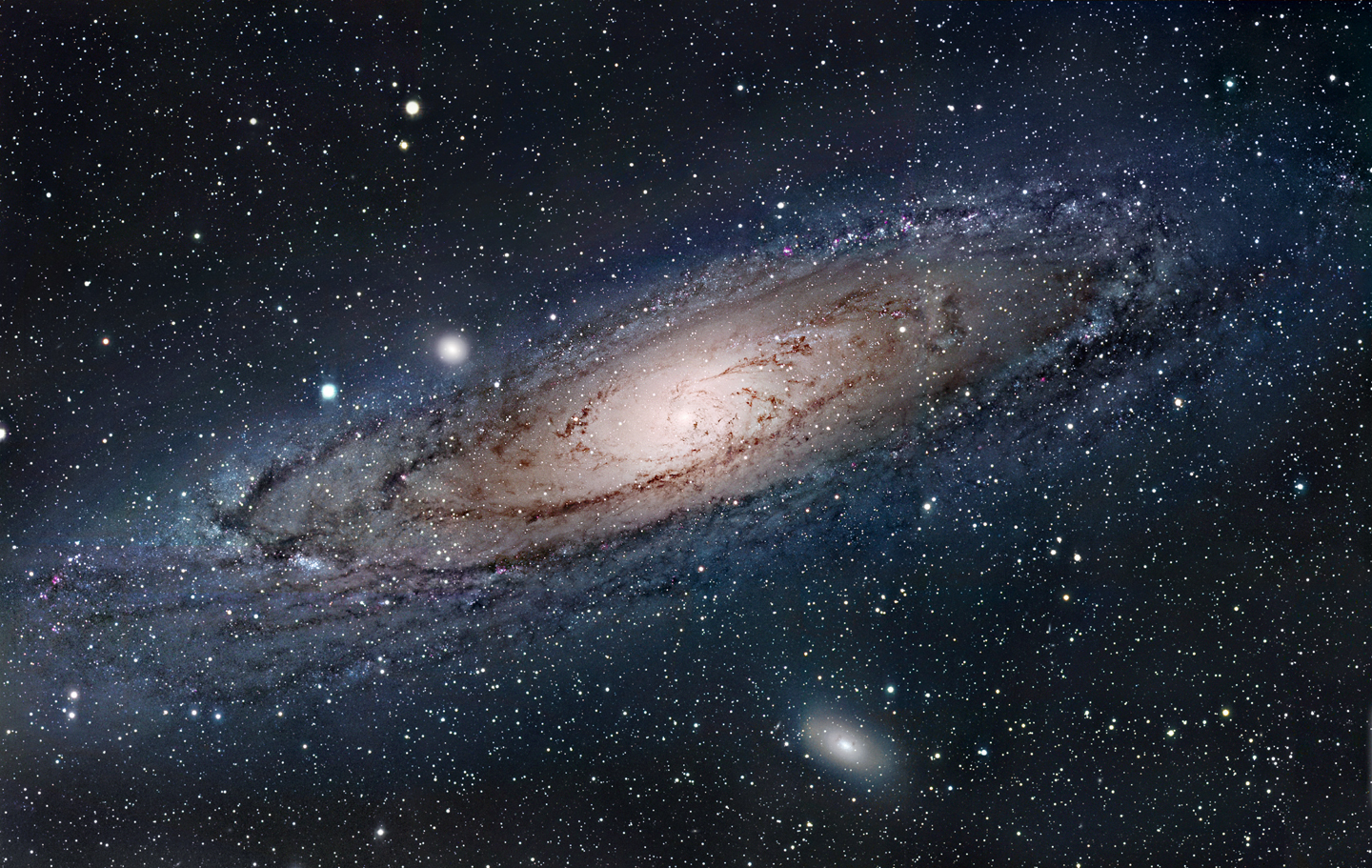
Andromeda, this swirling mass of stars, is a naked eye object - well, it is on clear, dark nights away from the glow of all or any street lights. It's the closest large galaxy to our own Milky Way, a mere 2½ million light years away, and is our sibling if not quite our twin. Together we are locked in an eternal dance of gravitation and it's thought that, at some time in the far distant future, we will pass through each other and perhaps even merge.
It is a beautiful thing, but looking with our own eyes can only reveal part of that beauty. Last December saw the launch of WISE (Widefield Infrared Survey Explorer), a space telescope designed to take images at wavelengths between 5 and 35 times longer than the human eye can see. It is discriminating between different sources of heat. The first results have just been released and are very impressive as this glorious new image shows.
Yes, that's Andromeda again. A little rotated compared to the top image but you get that in astronomy.
The bright yellows and reds are bands of dust, heated up by young stars forming within the clouds. The blue haze comes from older stars which have long absorbed or blown away any gas and dust. You can see the same dust in the optical picture as dark lanes blotting out the starlight. Now it comes into proper focus, beautiful.
----------------------------
Images from Big Cigar Astronomy and APOD. Grow into these trousers... >>
Saturday, 7 November 2009
In praise of Spitzer
 Launched in 2003, the Spitzer infrared space telescope is past the end of its primary mission. The coolant for the main camera is all used up, but even so there is still important scientific work it can do.
Never quite so visually stunning as Hubble, the results from Spitzer are sometimes astonishing and still worth a look.
The following video from IRrelevant astronomy outlines some of the findings from Spitzer and is presented by Felicia Day and Sean Astin.
Hang on ...
That Felicia Day? This Sean Astin. Yup, seems right (?)
Behind the Scenes: When Galaxies Collide
---------------------
HT BA Grow into these trousers... >>
Monday, 10 August 2009
Something to watch out for

My head feels to be full of cotton wool this evening, so just a quick reminder to watch out for the Perseid meteor shower over the next few nights.
If the skies are clear after dark, look NE and let your eyes adjust. There's a good chance to see over ~60 shooting stars an hour, though this year the rising Moon will wash out the fainter ones. I hope you're lucky! Grow into these trousers... >>
Friday, 7 August 2009
Why we should search for ET
“I wish that you would empower Earthlings everywhere to become active participants in the ultimate search for cosmic company" - Jill Tarter.Astronomer Jill Tarter is director of the Center for SETI (Search for Extraterrestrial Intelligence) Research. Watch her powerful speech as she accepts the TED prize earlier this year [21:24].
Why the search for alien intelligence matters
Grow into these trousers... >>
Friday, 15 May 2009
A landmark day for astronomy
The Hubble Space Telescope gets an upgrade, kudos to the crew of Atlantis, and two more space telescopes were successfully launched - Herschel and Planck.
 Herschel carries the largest mirror ever on a spacecraft. At 3.5m it has twice the collecting area as Hubble (2.4m), but will examine the universe in different a different part of the spectrum. It's designed to detect long wavelength infrared, it will peer through the dust which often obscures inner detail in Hubble images.
Plank is an orbiting thermometer. Carrying a range of detectors to pick up microwaves it will scan the ubiquitous background radiation of the Big Bang. With exquisite sensitivity it will add to the understanding of how the universe came to be and how the distant future may unfold.
2009: Herschel and Planck (ESA)
The data will be amazing, but we have to wait 'till next year until they reach operational position. Herschel and Planck are not intended to last very long either. A two or three years of use will deplete their coolant systems, and their great distance means no service missions are possible. But later, the unravelling of the findings over many more years, will inspire a generation. Grow into these trousers... >>
Herschel carries the largest mirror ever on a spacecraft. At 3.5m it has twice the collecting area as Hubble (2.4m), but will examine the universe in different a different part of the spectrum. It's designed to detect long wavelength infrared, it will peer through the dust which often obscures inner detail in Hubble images.Plank is an orbiting thermometer. Carrying a range of detectors to pick up microwaves it will scan the ubiquitous background radiation of the Big Bang. With exquisite sensitivity it will add to the understanding of how the universe came to be and how the distant future may unfold.
2009: Herschel and Planck (ESA)
The data will be amazing, but we have to wait 'till next year until they reach operational position. Herschel and Planck are not intended to last very long either. A two or three years of use will deplete their coolant systems, and their great distance means no service missions are possible. But later, the unravelling of the findings over many more years, will inspire a generation. Grow into these trousers... >>
Thursday, 14 May 2009
Herschel and Planck are ready for launch

Two new space telescopes are set to launch in a couple of hours aboard the same Ariane 5 rocket. Watch it live on Mogulus.
White knuckle time again, here's hoping for a great mission.
More to follow later today.
UPDATE: Launch successful and bang on time. Grow into these trousers... >>
Sunday, 26 April 2009
Centaurus A - Or wow, what a pretty picture

"The Chandra X-ray observatory has taken a closer look at the galaxy Centaurus A, and new images have revealed in detail the effects of a shock wave blasting through the galaxy. Powerful jets of plasma emanating from a supermassive black hole at the galactic core are creating the shock wave, and the new observation, have enabled astronomers to revise dramatically their picture of how jets affect the galaxies in which they live."Read more at Universe Today. Grow into these trousers... >>
Sunday, 5 April 2009
Oh what a beautiful morning
Don't worry, I'm not going to start singing.
This happened last Thursday and I wanted to post about it then but real life intervened (nothing too bad, but enough to gobble up my free time - I might post on that later).
Anyway, it was a clear, warm, sunny morning and I was full of the joys of spring.
What put me in such a good mood? It was simple, unexpected and interesting. Early morn, before I even pulled back the curtains, I had made a coffee and was sitting at my desk when I noticed a brightness over my shoulder. There, cast on the white-painted room door, was a perfect circle of light. About 3cm across and fully in focus. The nerd in me must have kicked in because I knew what it was. My house faces due East, and a tiny chink in the curtains was making a pinhole camera and throwing an image of the rising Sun across the room. Whoa! Over the next half hour I watched the image track down, after blu-tacking a sheet of white paper on the door for better viewing. As hard as I looked though, the disc of the Sun was featureless.
Well, I kinda knew that sunspot activity was at a minimum, but no sunspots at all? Well it's true, this is the lowest sunspot minimum since 1913.
This has a knock on effect for us all. It means that satellite communications have less noise and fewer errors for instance, GPS accuracy improves and electricity grids are less prone to failure. On the minus side the displays of aurora diminish and the weaker solar wind allows more high-energy cosmic radiation to penetrate the heliosphere. This increases the radiation dose received by astronauts, a possible long term health hazard.
The Sun will recover, the 11 year cycle has been very regular since records have been kept, but interestingly the long Maunder Minimum of sunspots, from 1645 to 1715, coincided with the coldest part of the Little Ice Age when much of Europe and North America experienced extremely deep and cold winters. That was the time when the river Thames would freeze over and entire communities had to be abandoned due to the severity of the weather.
Are we entering a new 'Maunder Minimum'? Who knows. Would that be enough to offset global warming? Unlikely but Nature is endlessly fascinating. Grow into these trousers... >>
This happened last Thursday and I wanted to post about it then but real life intervened (nothing too bad, but enough to gobble up my free time - I might post on that later).
Anyway, it was a clear, warm, sunny morning and I was full of the joys of spring.
What put me in such a good mood? It was simple, unexpected and interesting. Early morn, before I even pulled back the curtains, I had made a coffee and was sitting at my desk when I noticed a brightness over my
shoulder. There, cast on the white-painted room door, was a perfect circle of light. About 3cm across and fully in focus. The nerd in me must have kicked in because I knew what it was. My house faces due East, and a tiny chink in the curtains was making a pinhole camera and throwing an image of the rising Sun across the room. Whoa! Over the next half hour I watched the image track down, after blu-tacking a sheet of white paper on the door for better viewing. As hard as I looked though, the disc of the Sun was featureless.Well, I kinda knew that sunspot activity was at a minimum, but no sunspots at all? Well it's true, this is the lowest sunspot minimum since 1913.
This has a knock on effect for us all. It means that satellite communications have less noise and fewer errors for instance, GPS accuracy improves and electricity grids are less prone to failure. On the minus side the displays of aurora diminish and the weaker solar wind allows more high-energy cosmic radiation to penetrate the heliosphere. This increases the radiation dose received by astronauts, a possible long term health hazard.
The Sun will recover, the 11 year cycle has been very regular since records have been kept, but interestingly the long Maunder Minimum of sunspots, from 1645 to 1715, coincided with the coldest part of the Little Ice Age when much of Europe and North America experienced extremely deep and cold winters. That was the time when the river Thames would freeze over and entire communities had to be abandoned due to the severity of the weather.
Are we entering a new 'Maunder Minimum'? Who knows. Would that be enough to offset global warming? Unlikely but Nature is endlessly fascinating. Grow into these trousers... >>
Saturday, 4 April 2009
Star Formation: The Game
Via Bad Astronomy...
Set off supernovae to compress the gas cloud and trigger star formation.
Science and gaming together, bliss.

Here's an article on gas clouds and stars from the game's astronomy consultant, Adam Frank. Grow into these trousers... >>
Set off supernovae to compress the gas cloud and trigger star formation.
Science and gaming together, bliss.
Here's an article on gas clouds and stars from the game's astronomy consultant, Adam Frank. Grow into these trousers... >>
Friday, 30 January 2009
A quick reminder
 The 365 days of Astronomy podcast is now in full swing so if you aren't listening already give it a go. There's even an embedded player on the web page so you don't have to download anything, just click the play button. Recent episodes include Jupiter’s Great Red Spot and Telescopes in Space.
Today it will be Using Astronomy to Teach Kids about Science. What could be better?
Thursday, 15 January 2009
Astronomy software alert
Stellarium
If I went outside now and looked South East, there would be the constellation of Orion with the infamous star Betelgeuse.
 This is a very nice piece of software for an armchair astronomer like me. It simulates the sky in real time (or enter a date/time), from any location (or select a city), you can zoom in/out pan round/up/down, it has masses of easy-to-set configuration options and it's free (GPL).
Many thanks to The Strawman for the link. Grow into these trousers... >>
If I went outside now and looked South East, there would be the constellation of Orion with the infamous star Betelgeuse.
This is a very nice piece of software for an armchair astronomer like me. It simulates the sky in real time (or enter a date/time), from any location (or select a city), you can zoom in/out pan round/up/down, it has masses of easy-to-set configuration options and it's free (GPL).Many thanks to The Strawman for the link. Grow into these trousers... >>
Sunday, 4 January 2009
Lots to do in 2009
 Just a reminder that 2009 is The International Year of Astronomy, so pay them a visit and see what events might be in your area.
The daily podcast is up and running and well worth a listen. Just now I'm listening to Who Ordered the Dark Matter and Dark Energy? with Fraser Cain and Pamela Gay from Astronomy Cast.

In addition, 2009 will see the bicentenary of the birth of Charles Darwin on February 12th and the 150th anniversary of the publication of On the Origin of Species on November 24th. Watch out for lots evolution themed things this year like the current exhibition at The Natural History Museum.
Happy science year! Grow into these trousers... >>
Sunday, 21 December 2008
Happy Solstice
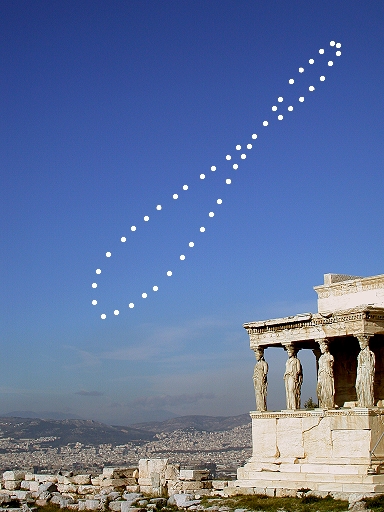 I was reminded by the Astronomy Picture of the Day and Bad Astronomy that today is the Winter solstice, the day when the Sun reaches it's lowest point in the sky. Every day from now will see the Sun higher in the sky and gradually sunrise will come slightly earlier. Even though the worst of Winter may still be to come, here begins the countdown to Spring.
And if you do intend to party tonight, remember to wrap up warm before you go cavorting naked in the woods. It's cold at this time of year.
The Beatles - Here comes the sun
Grow into these trousers... >>
Subscribe to:
Posts (Atom)





 Posts
Posts


