
Showing posts with label Mars. Show all posts
Showing posts with label Mars. Show all posts
Wednesday, 8 August 2012
More cameras see light on Mars
With the mast now upright Curiosity's main cameras are waking up to greet the day. The navigational cameras were first to the bathroom. There are four of these, a pair on either side of the main cameras (which are still calibrating). All the mast cameras point the same direction, to give stereoscopic views wherever the mast head is turned.
 Here we are looking north, the rim of Gale crater rises in the distance. On the left, just below the centre line, are two apparent 'craters'. These were almost certainly blasted out by the thrusters on the sky crane as it hovered to lower Curiosity to the surface. Hi res colour must be soon.
Grow into these trousers... >>
Here we are looking north, the rim of Gale crater rises in the distance. On the left, just below the centre line, are two apparent 'craters'. These were almost certainly blasted out by the thrusters on the sky crane as it hovered to lower Curiosity to the surface. Hi res colour must be soon.
Grow into these trousers... >>

![[Stumble Upon]](http://cdn.stumble-upon.com/images/16x16_su_3d.gif)

A birds eye view of Curiosity
After it captured Curiosity (MSL) parachuting down, the Mars Reconnaissance Orbiter had another look at the landing site.
 MRO was a lot further away on this orbit pass so the resolution isn't so high, however the components which put Curiosity down safely are all clear. The sky crane and parachute are to the left of Curiosity, some 600m away. The heatshield is to the lower right. In about a week the orientation of MRO will be more favourable and another image is planned. Such images will help determine the exact position of Curiosity and let the rover team plan the next move once all the systems have been checked out.
Grow into these trousers... >>
MRO was a lot further away on this orbit pass so the resolution isn't so high, however the components which put Curiosity down safely are all clear. The sky crane and parachute are to the left of Curiosity, some 600m away. The heatshield is to the lower right. In about a week the orientation of MRO will be more favourable and another image is planned. Such images will help determine the exact position of Curiosity and let the rover team plan the next move once all the systems have been checked out.
Grow into these trousers... >>

Tuesday, 7 August 2012
Shadows of Martian Curiosity
OH WOW!
 Curiosity stands in Gale crater, looking forwards to the east-southeast, in the late afternoon. The long shadow of Curiosity reaches out towards the mountains some 6km away (it may be further). Is this the central peak of the crater? I'm not sure but possibly not. If it's a foohill what will Mount Sharp look like?
This still just a low res hazcam, though a front one this time, with the original fisheye view stretched out to look normal. The mast with the hi res cameras will be deployed tomorrow, also the High Gain Antenna has been deployed to give a direct link to Earth. It's working, but full speed comms won't come through till later. Data rates from MRO and Odyssey relays are to be increased so final data speeds will go up about 5x, maybe even to megabits/s ie slow broadband speeds in bursts. Stand by to be really amazed. Grow into these trousers... >>
This still just a low res hazcam, though a front one this time, with the original fisheye view stretched out to look normal. The mast with the hi res cameras will be deployed tomorrow, also the High Gain Antenna has been deployed to give a direct link to Earth. It's working, but full speed comms won't come through till later. Data rates from MRO and Odyssey relays are to be increased so final data speeds will go up about 5x, maybe even to megabits/s ie slow broadband speeds in bursts. Stand by to be really amazed. Grow into these trousers... >>
Another view of Curiosity's heatshield
As MRO was passing overhead Curiosity took it's own pictures with a camera on it's belly. With the parachute deployed the camera began clicking at 4 frames per second when the heatshield was dropped. Here's one of the first frames:
 NASA have put together a low res, 4fps video of the whole descent. You can see the heatshield fall away and watch for the dust cloud thrown up at the end by the thrusters. The high res images will come through in a day or two.
Grow into these trousers... >>

Grow into these trousers... >>
Flash, bang, wallop, what a picture!

The Mars Reconnaissance Orbiter has done it again!* As it passed overhead the mighty HIRISE camera had one chance to capture the scene; here is the result. From over 300km away not only is Curiosity clearly visible, dangling on it's parachute, but below is the heatshield!
But look again. There is no disturbance on the surface around the heatshield, no crater, no dust cloud.
Conclusion - it's still falling!
I stand in awe of these guys - well no, in truth I sit because if I stand I'll pass out due to lack of sleep. Fuck the Olympics, the real action is 14 light minutes away on Mars.
*Four years ago MRO imaged the Phoenix lander in it's descent to the surface. Grow into these trousers... >>
Wednesday, 29 July 2009
I'm going to Mars next
Some folks were interested in my 'I'm going to the Moon' post, and the follow-ups about the LRO/LCROSS mission. The best is yet to come there!
Even more amazing is this:

How did I get my name on the Mars Science Laboratory? Easy, just like LRO I signed up online. You can do the same. Read about it and sign up here. Bookmark your certificate page to go back.
See you on the Red Planet. Grow into these trousers... >>
Even more amazing is this:
How did I get my name on the Mars Science Laboratory? Easy, just like LRO I signed up online. You can do the same. Read about it and sign up here. Bookmark your certificate page to go back.
See you on the Red Planet. Grow into these trousers... >>
Tuesday, 11 November 2008
Final news from Phoenix

Artists impression - Credit: NASA
As the Martian winter sets in, and the days shorten, there is no longer enough solar energy to power the circuits or charge the batteries. For a few days Phoenix struggled to maintain contact with the orbiting satellites but this was draining the batteries and shutting down the computer. If the batteries recharged at all the computer would reboot and try again to establish contact, which drained the batteries. Once looping like that there was nothing the mission controllers could do but call it the end. Ever decreasing circles as daylength declines.
Phoenix was designed to operate for just 90 days. It has far exceeded expectation and the scientific legacy will be studied for years to come.
So it's farewell to a fantastic mission. Will Phoenix arise a year from now in the next Martian spring? This is very unlikely. As winter progresses Mars' northern polar cap will grow and will entomb Phoenix; not in water ice but in sold CO2, dry ice.
People will be listening though and next year, if there is a beep, then this Phoenix will have arisen not from ashes but from ice.
For a brief overview of Phoenix, the podcast Quirks and Quarks has a good report from a few days ago, before the shutdown. Download it from here. Or you can read my earlier posts here. Grow into these trousers... >>
Saturday, 4 October 2008
Phoenix, a long awaited update

Watching the clouds go by.
Credit: NASA/JPL-Caltech/University Arizona/Texas A&M University
Credit: NASA/JPL-Caltech/University Arizona/Texas A&M University
Recently, results from the experimental kit on Phoenix have been slow to be released. Now suddenly there's all this fascinating stuff at once.
The gentle but persistent heat of the analyser ovens (TEGA - Thermal and Evolved Gas Analyzer) and the wet chemistry lab (MECA - Microscopy, Electrochemistry and Conductivity Analyzer) have both recorded firm evidence for calcium carbonate in 'soil' samples from Mars.
From NASA:
The TEGA evidence for calcium carbonate came from a high-temperature release of carbon dioxide from soil samples. The temperature of the release matches a temperature known to decompose calcium carbonate and release carbon dioxide gas, which was identified by the instrument's mass spectrometer.Calcium carbonate is limestone, or chalk or marble and can even form cave features such as stalactites. It is also an integral part of many marine organisms on Earth. Don't be confused though, there is no evidence for life on Mars, just carbonates which chemically are to be expected given Mars' CO2 based atmosphere, but it needs water. It's a bit like this:
The MECA evidence came from a buffering effect characteristic of calcium carbonate assessed in wet chemistry analysis of the soil. The measured concentration of calcium was exactly what would be expected for a solution buffered by calcium carbonate.
H2O + CO2 --> H2CO3
Water plus carbon dioxide gives carbonic acid. Now, remember what happens when you mix a metal, such as calcium, and an acid?
Ca + H2CO3 --> Ca2CO3 + H2
You get a salt, calcium carbonate, and hydrogen gas.
----------------
Another part of MECA is the atomic force microscope. They (try to) sieve in some dust from the Martian 'soil' and scan the surface of the particles with incredible precision. Here's an image:

This image's field of view is approximately 23 microns wide. That's 23µm or 23×10−6m, or 23/1,000,000 metres. That's at the low end of human hair width. It's described as platey material, flat sheets with clearly defined edges.
"We are seeing smooth-surfaced, platy particles with the atomic-force microscope, not inconsistent with the appearance of clay particles," said Michael Hecht, MECA lead scientist at NASA's Jet Propulsion Laboratory in Pasadena, Calif.Clay!
Clay minerals are typically formed over long periods of time by the gradual chemical weathering of rocks (usually silicate-bearing) by low concentrations of carbonic acid.TEGA has also found hints of phyllosilicates, These results just drip with water.
Here's the stunner though. It was snowing on Mars.
Martian clouds, like those in the animation above, have been followed by the Meteorological Station (MET) aboard Phoenix. It caries a LIDAR or light detection and ranging instrument. Basically a radar but done with a laser beam.

Watching the clouds go by, with a laser.
Credit: NASA/JPL-Caltech/University Arizona/Canadian Space Agency
Credit: NASA/JPL-Caltech/University Arizona/Canadian Space Agency
Something was dropping out of the clouds and being buffeted by the differing wind speeds as it fell. Ice crystals; we might call it snow.
It can't be frozen carbon dioxide, it's not cold enough for that yet. It is very cold though:

A thin layer of water frost is visible on the ground around NASA's Phoenix Mars Lander in this image taken by the Surface Stereo Imager at 6 a.m. on Sol 79 (August 14, 2008), the 79th Martian day after landing. The frost begins to disappear shortly after 6 a.m. as the sun rises on the Phoenix landing site.
Credit: NASA/JPL-Caltech/University of Arizona/Texas A&M University
As the winter progresses it will get much colder still. Cold to the point where Phoenix will cease to function, and be entombed in ice and solid CO2. Until the Martian spring that is. As the polar cap again retreats Phoenix will be re-exposed and, if the sunlight charges up it's batteries, it may just manage a last "Still Here". I hope so, this is a great mission. Grow into these trousers... >>
Monday, 29 September 2008
Phoenix - These Mars landers just keep givin'
I have just learned that Phoenix has positively identified carbonates on Mars. Crucially, calcium carbonate, that's like chalk and limestone and wow! To me it implies standing water. More later...
Grow into these trousers... >>
Sunday, 3 August 2008
Is it ice? Part 3 - Yes!
Water on Mars:
 Photo credit : Rob @ Bayblab
OK, I've dithered about this. Pull up your trousers here and here.
Not that I ever really doubted that ice was present on Mars. The polar caps have been known to be composed of water ice(15%) and frozen carbon dioxide (CO2 - dry ice - 85%) from a long time back.
But you want that final cherry. The tension has been well, tense; with oven doors failing to open correctly, fears of a short circuit and claggy Marsdust but finally the robot arm has delivered a (small) scoopful of the solid stuff to a properly working TEGA slot.
This instrument gently warms up the sample and measures the molecular/atomic weight of the gases which evaporates off. Guess what, at 32°F (0°C for the non-Americans) a phase change was observed - that's something melting. In the evolved gases, a signal with a mass of 18 was detected!
H - Hydrogen : atomic weight = 1
O - Oxygen : atomic weight = 16
H2O - Water : molecular weight = 1+1+16 = 18
What were you expecting, some alloy of Lithium and Boron? Dihydro quodrahelium (He4H2)? Nah, look it up. That was water. I am convinced, but what I want to know now is did they see any deuterium 2H or any 18O. These are heavy isotopes of hydrogen and oxygen and the isotope ratios can provide a lot of information on how the ice may have formed.
In the same press release from NASA a five week extension to the Phoenix mission was announced. This will keep data coming back until early November rather than stopping at the end of August. After that the Martian winter will be setting in, light levels will fall and the solar panels will cease to work. Phoenix will freeze :(
-----------------
Update: Emily Lakdawalla notes the sample was too small to observe a deuterium to hydrogen ratio. Oh well, better luck next time.
Grow into these trousers... >>
 Photo credit : Rob @ Bayblab
OK, I've dithered about this. Pull up your trousers here and here.
Not that I ever really doubted that ice was present on Mars. The polar caps have been known to be composed of water ice(15%) and frozen carbon dioxide (CO2 - dry ice - 85%) from a long time back.
But you want that final cherry. The tension has been well, tense; with oven doors failing to open correctly, fears of a short circuit and claggy Marsdust but finally the robot arm has delivered a (small) scoopful of the solid stuff to a properly working TEGA slot.

This instrument gently warms up the sample and measures the molecular/atomic weight of the gases which evaporates off. Guess what, at 32°F (0°C for the non-Americans) a phase change was observed - that's something melting. In the evolved gases, a signal with a mass of 18 was detected!
H - Hydrogen : atomic weight = 1
O - Oxygen : atomic weight = 16
H2O - Water : molecular weight = 1+1+16 = 18
What were you expecting, some alloy of Lithium and Boron? Dihydro quodrahelium (He4H2)? Nah, look it up. That was water. I am convinced, but what I want to know now is did they see any deuterium 2H or any 18O. These are heavy isotopes of hydrogen and oxygen and the isotope ratios can provide a lot of information on how the ice may have formed.
In the same press release from NASA a five week extension to the Phoenix mission was announced. This will keep data coming back until early November rather than stopping at the end of August. After that the Martian winter will be setting in, light levels will fall and the solar panels will cease to work. Phoenix will freeze :(
-----------------
Update: Emily Lakdawalla notes the sample was too small to observe a deuterium to hydrogen ratio. Oh well, better luck next time.
Grow into these trousers... >>
Friday, 20 June 2008
Is it ice? Part 2
Pull up your trousers: Is it ice?
A few sols back (a 'sol' is a Martian day) the robotic arm on Phoenix dug a trench which uncovered some white material. There was excitement about ice but nothing could be said for sure until more analysis. Note that in this image the bright white areas at the top of the trench are difficult to interpret. It all depends on how you set the contrast. I would rather draw your attention to the light coloured 'pebbles' in the shadow at the bottom left.
If the white stuff was ice then, exposed to the thin Martian atmosphere and warmed by the Sun, it would sublimate. That is, the ice would not melt as it does back home, but evaporate directly from solid to gas with no intermediate liquid phase. It's the same behavior we see on Earth with dry ice (frozen carbon dioxide).
In the meantime a soil sample delivered to one of the analyser ovens showed no trace of water. Emily Lakdawalla explains:
No surprise there then. If there had been ice in the sample it would have evaporated away before reaching the oven.
So what has happened in the trench, 4 sols since the first photo?
This is not phototrickery. It's real.
Some folks are saying this is proof of ice, even the Phoenix team themselves. Others, such as Emily Lakdawalla, are more cautious.
I'm still hesitating to say I'm fully convinced. Not that I think alien pixies flew off with those lumps during the darksol, I just want to see a water signal in the gas analyser.
Grow into these trousers... >>

A few sols back (a 'sol' is a Martian day) the robotic arm on Phoenix dug a trench which uncovered some white material. There was excitement about ice but nothing could be said for sure until more analysis. Note that in this image the bright white areas at the top of the trench are difficult to interpret. It all depends on how you set the contrast. I would rather draw your attention to the light coloured 'pebbles' in the shadow at the bottom left.
If the white stuff was ice then, exposed to the thin Martian atmosphere and warmed by the Sun, it would sublimate. That is, the ice would not melt as it does back home, but evaporate directly from solid to gas with no intermediate liquid phase. It's the same behavior we see on Earth with dry ice (frozen carbon dioxide).
In the meantime a soil sample delivered to one of the analyser ovens showed no trace of water. Emily Lakdawalla explains:
No surprise there then. If there had been ice in the sample it would have evaporated away before reaching the oven.
So what has happened in the trench, 4 sols since the first photo?
This is not phototrickery. It's real.
Some folks are saying this is proof of ice, even the Phoenix team themselves. Others, such as Emily Lakdawalla, are more cautious.
I'm still hesitating to say I'm fully convinced. Not that I think alien pixies flew off with those lumps during the darksol, I just want to see a water signal in the gas analyser.
Grow into these trousers... >>
Thursday, 12 June 2008
Is it ice?

NASA's astronomy picture of the day (APOD) gives a tantalising look underneath the Phoenix lander.
Hi-res is here.
-----
Edit: just after I posted this I learned that the robotic arm has delivered soil samples to both the optical microscope and one of the gas analyzer ovens. GO, GO Phoenix.
Saturday, 31 May 2008
One of the greatest images I have ever seen.
 Heimdall crater, Mars. Just south of the northern polar ice cap, but inside the 'arctic circle'.
OK it don't look like much, just another crater, yawn... Read on for the background before I show the full image. (grin)
Late last Sunday Night/Monday morning (25th/26th May) I had the best white knuckle ride for years. The Phoenix lander made safe touchdown on Mars. I was sat at home, watching NASA TV on the net with live video and commentary from the control room, and the atmosphere was electric. For the last few minutes I was hanging onto my desk and willing this thing down. (of course the radio signal takes time to come to Earth, about 15 mins that night, so it all had happened by the time anyone knew).
But, touchdown! It all worked, and by 'all' I mean watch this simulation...
OK it's a CGI simulation, but it may give a feel of the occasion. Note also that this thing comes down on thrusters. That's technically very difficult. Usually parachutes are used slow the craft enough for airbags to absorb the shock of impact. Phoenix was too heavy for this, it's carrying a lot of science hardware. Phoenix flew!
Satellite ballet

At the same time, the flight controllers of three (count them) satellites currently in orbit around Mars had re-positioned their crafts to relay data, take photos, and provide backup. Phoenix is coming in from the top left
NASA's Mars Reconnaissance Orbiter (MRO) is on point to relay signals and take pictures with the best camera ever. Nearby is Mars Odyssey, and Europe's Mars Express in a wider orbit but close enough to (metaphorically) give them a wave and pick up the baton should there be major problems.
However it all went to the perfection of ballet, or better. Signals from the lander were coming in, high fives were given round the control room and I'm sure only just missed the champagne as I went to bed.
First Images
Monday morning I woke up to pictures like these:
First view of Mars

Phoenix checks out one if it's 3 landing legs.

Where did it land?
Here's a rough idea of the landing site

The blue ellipse is the area of the predicted landing zone. That's where Phoenix was aiming. The red circle encloses where It really did land, the red dot is the most probable place. It seems Phoenix almost overran the target. Something happened.
I've heard that the parachute deployed a bit late, I've also heard that it should have opened as Phoenix reached a certain speed. Did mission control underestimate local air pressure? They got the weather wrong maybe? Well that's not surprising.
The thing to note is the big round orange blob just right of Phoenix. That is Heimdall crater from the first image above. The red rectangle is/was the predicted path of MRO with the amazing HiRISE camera aboard. As Phoenix comes down and MRO goes overhead, HiRISE is aimed, guided by radio triangulation with Odyssey i guess, so it's pointing to the East and down a bit towards Heimdall crater, and HiRISE took a picture.
This is the first OMG shot I saw

Here's a blowup

It's amazing. A man made object descending onto an alien world, photographed by another man made object. Phil Plait, the Bad Astronomer, says it much better than I can.
But all of this is just a teaser for the real image.
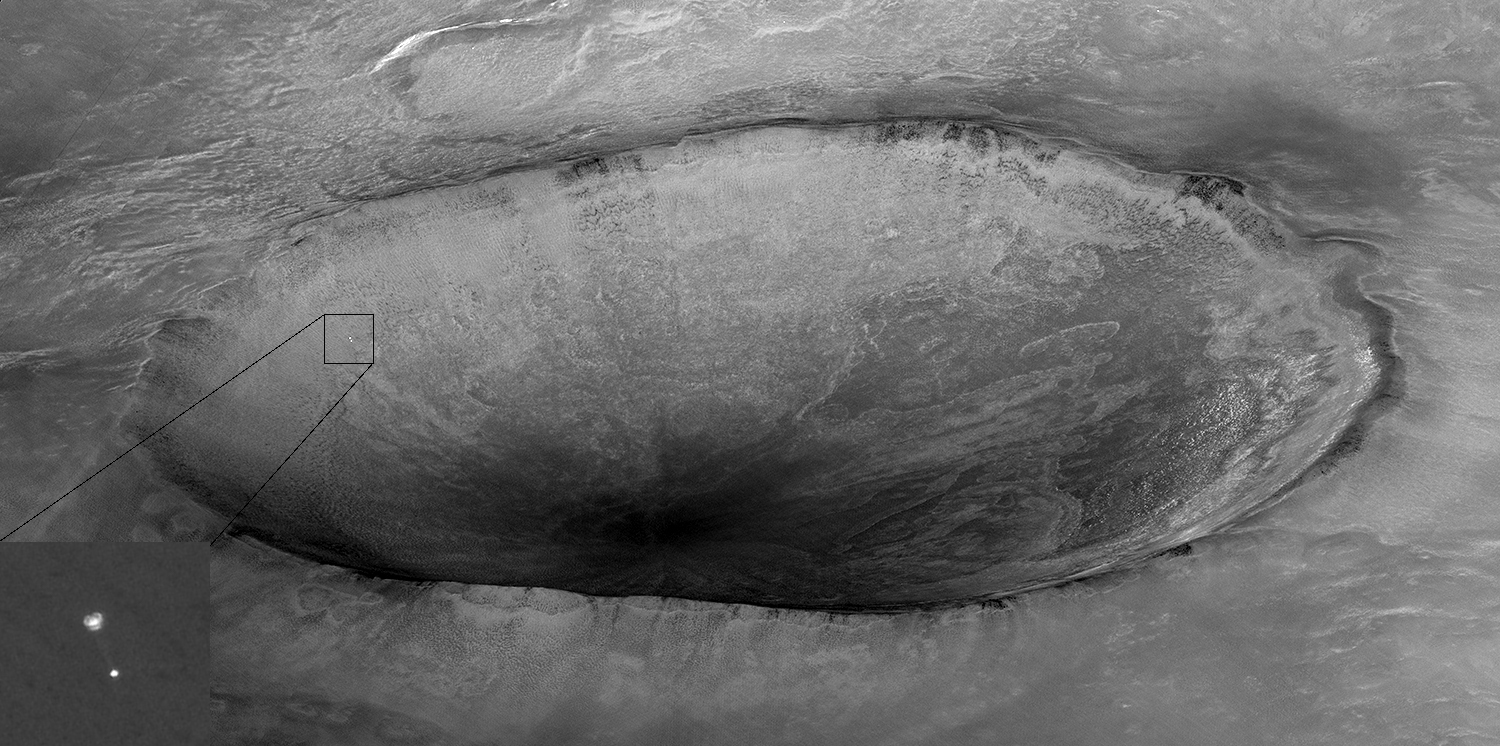 Click on the picture to see it full screen - get it as big as you can. Then sit back in awe as to what humans can do.
Note: Heimdall crater is 10km across and Phoenix is much closer to the camera than it appears, about 20km closer.
=====
Check out the Phoenix homepage for more info and pictures and read Emily Lakdawalla's blog at the Planetary Society.
Grow into these trousers... >>
Subscribe to:
Posts (Atom)





 Posts
Posts


